
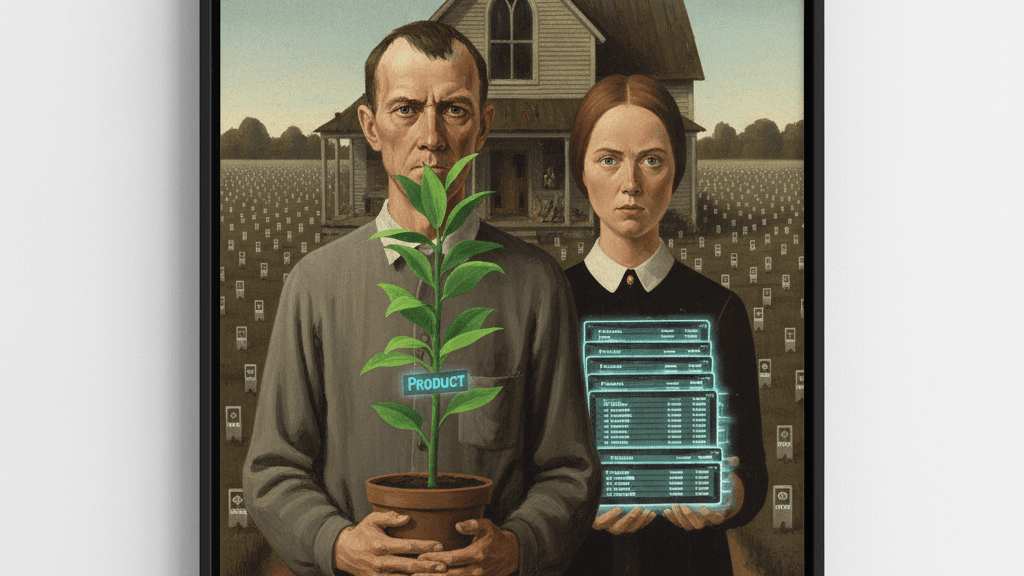
The Slow Death Of Strategy
Executives get excited about shiny things. AI features, competitor launches, and conference demos create a sense of urgency. Instead of asking whether a move matters, the conversation jumps straight to how quickly it can be shipped.
That shift changes the team's job. The question stops being what problem is worth solving and becomes how to build whatever the loudest voice wants next.
The Feature Farm Trap
Feature farming looks like product management. There are still backlogs, requirements, stories, and roadmap reviews. But the muscle has atrophied.
The team's energy goes into execution rather than judgement. It becomes easier to ship output than to defend an outcome.
How Executives Accidentally Break Teams
Very few leaders are trying to create a feature farm. The pattern usually emerges from understandable behaviour under pressure.
- Idea tsunami: every meeting generates a new must-have.
- Comparison trap: competitor launches become automatic justification.
- Demo delusion: slick concepts get mistaken for proven value.
The Real Cost
The obvious cost is product bloat: more complexity, more surface area, more confusion. The hidden cost is worse. Teams lose the craft of product management itself.
When discovery disappears, intuition weakens. When teams stop making decisions, they become easier to replace because anyone can execute someone else's roadmap.
The Collaborative Cure
The antidote is not louder pushback. It is a better decision structure. Bring executives, engineers, designers, and customer evidence into the same conversation.
When leaders see users struggle with their pet idea, priorities change. Discovery becomes less about resistance and more about shared learning.
Timeboxed Discovery
One practical way to protect strategy is to timebox discovery. Instead of dragging the debate out for weeks, create a short, focused cycle that tests the assumptions behind the request.
- Frame the decision clearly.
- Map customer friction and competing assumptions.
- Prototype the strongest response fast.
- Test with real users before the roadmap absorbs the cost.